
You ever wondered if you closed your garage door when you left? With Home Assistant, you can use a simple sensor to always know if your garage door is open or closed. It’s not only convenient, but also adds a layer of security and peace of mind. In this guide, I’ll show you some of the best garage door sensors for Home Assistant, what to look for when choosing one.
If you have already bought a sensor and are looking for how to install and configure it, you can read my guide on that here: 2 Easy Ways to Monitor your Garage Door with Home Assistant (Guide)
What to Look For in a Garage Door Sensor
When choosing a garage door sensor for Home Assistant, there are a few things to consider:
- Protocol (Wi-Fi, Zigbee, Z-Wave) – Wi-Fi is easy set up, but Zigbee/Z-Wave often uses way less power, and are more reliable.
- Battery life – Almost all sensors are battery-powered, so you’ll want one that lasts at least one year. Often Zigbee sensors are chosen, because it’s superior to Wi-Fi when it comes to power usage.
- Integration with Home Assistant – Make sure your sensor is supported by ZHA, Zigbee2MQTT, or works with an integration.
- Price – You don’t want to blow your whole smart home budget on just one sensor.
Best Garage Door Sensors for Home Assistant
Below are three great options for monitoring your garage door with Home Assistant. Whether you prefer Zigbee or Wi-Fi, these sensors are affordable, reliable, and easy to integrate.
Affiliate Disclosure: As an Amazon Associate I earn from qualifying purchases. The links below are affiliate links — if you buy through them, I may earn a small commission at no extra cost to you.
| Sensor | Protocol | Method | Why choose this one? | Link |
| THIRDREALITY Zigbee Smart Garage Door Tilt Sensor | Zigbee | Tilt | Cheap and simple | View on Amazon |
| Aqara Vibration Sensor | Zigbee | Tilt | Offers longer battery life | View on Amazon |
| Smart WiFi Door Sensor | Wi-Fi/Tuya | Contact | It’s cheap and works with Tuya | View on Amazon |
I’ve personally found Zigbee sensors to be much more reliable over time. They use almost no power, and once you have a Zigbee coordinator, adding new sensors is effortless.
Wi-Fi sensors can work too — especially if you don’t have Zigbee yet — but they can drain batteries faster and depend on a stable network connection.
My personal favorite is the Aqara Vibration Sensor. It’s small, lasts forever on a single battery, and integrates perfectly with ZHA or Zigbee2MQTT.
Tips for Better Accuracy and Reliability
Even the best sensor can give false readings if mounted or configured incorrectly. Here are a few ways to improve reliability:
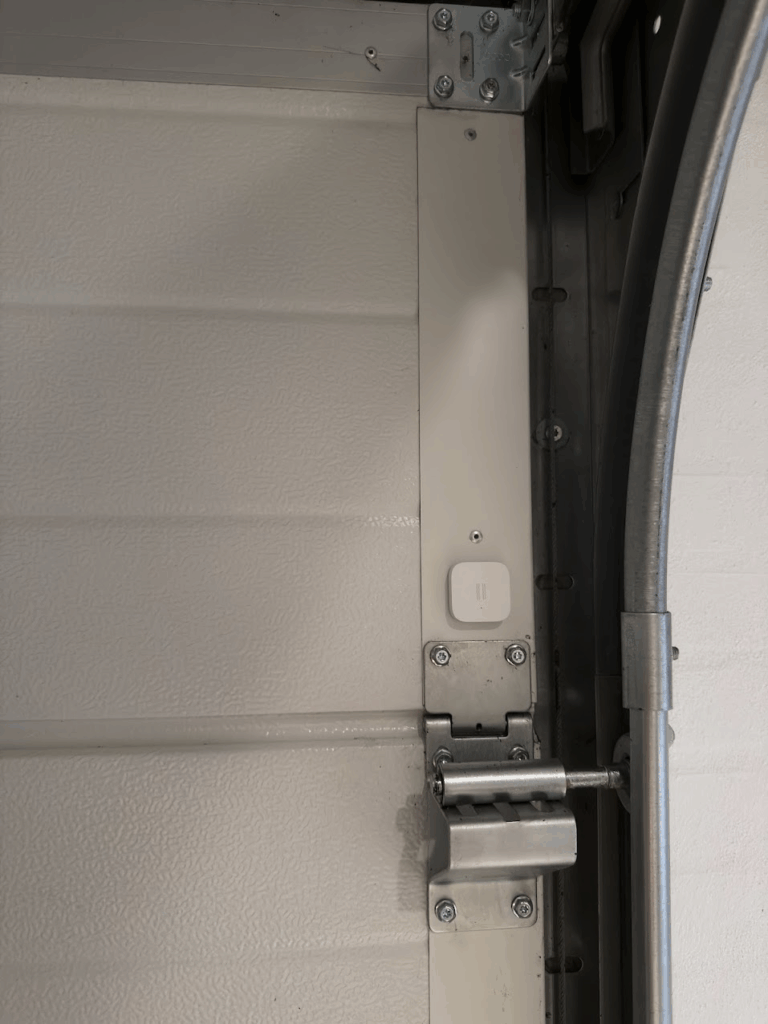
- Mount the sensor on the top panel of the garage door. Now if the garage door is only slightly open, then sensor will still read “open”.
- Make sure the connection is good enough, whether you are using Zigbee, Z-Wave or Wi-Fi.
- Keep an eye on the battery level. Most garage sensors are battery-powered, and a dead battery can easily go unnoticed until you realize the door status hasn’t updated for a while.